Buddachannel - « EES: philosophy by parables »
Who is the shadowy Shomintsu who claims to "see a fat man" in Jun, a lanky teenager eking out an existence peddling photo stories on the streets of Tokyo? Tokyo is vast, but Shomintsu is forever turning up on Jun's path. Eventually, he tells him that he is the head of a sumo wrestling school, and he invites Jun to watch a match. The tormented youth comes to see that a sport he had dismissed as stupid is in fact the way to wisdom. He learns to step back from himself the better to discover who he is, and to off-load his past so as to put his weight behind the future. Filled with self-loathing, convinced that no one, not even his angelic mother, loves him, Jun soon learns to master his emotions through concentration and meditation. The most mysterious of the martial arts initiates him into Zen philosophy and gradually transforms his hatred of everything into a passion for life. At 18, the young man has discovered that "behind the clouds, there is always a heaven".
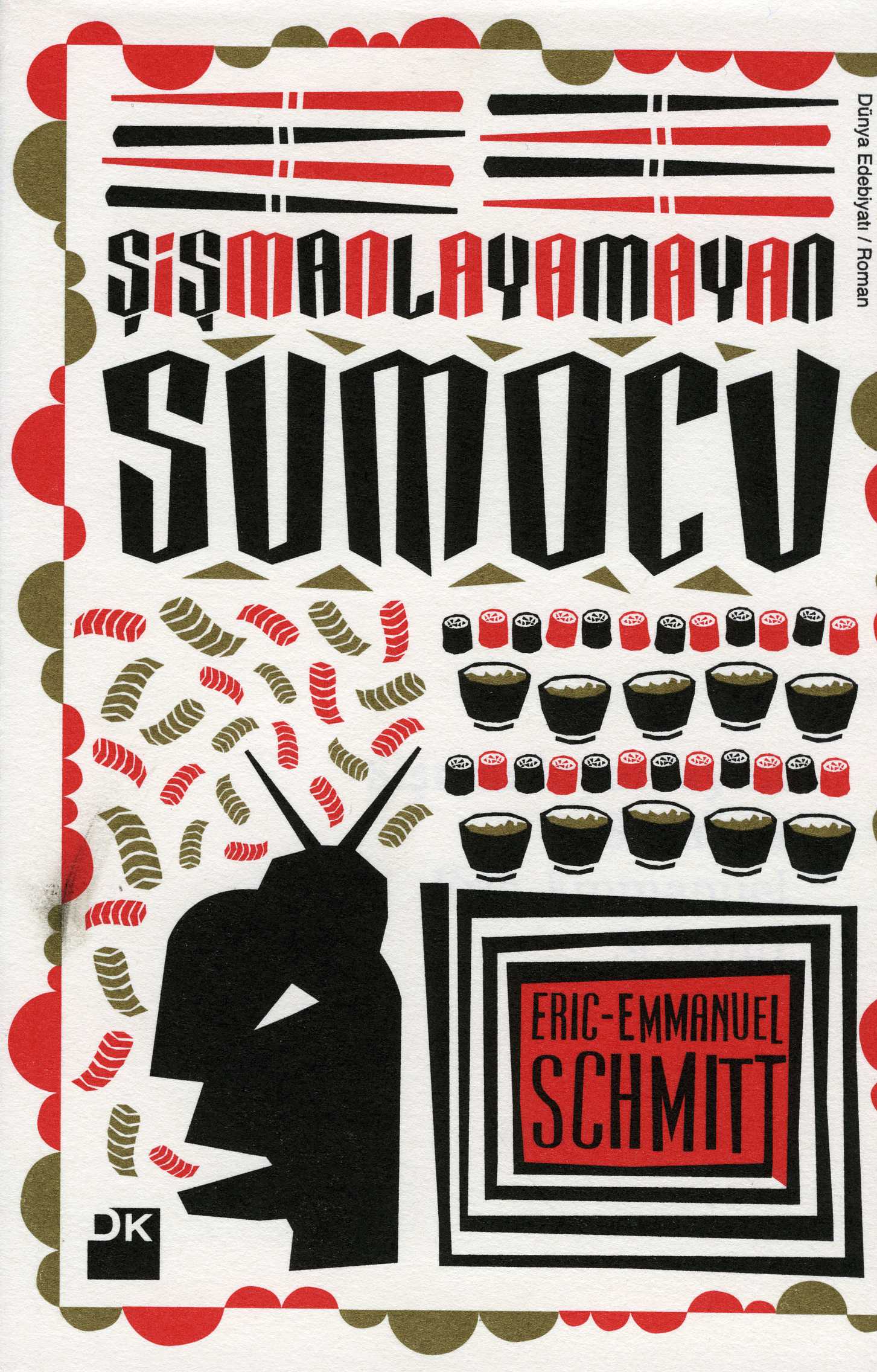
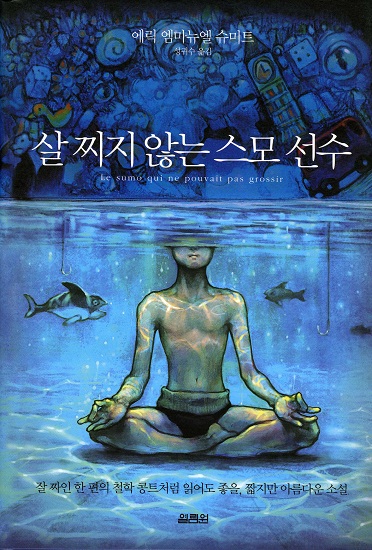
With The Sumo Wrestler Who Could Not Get Fat, a Buddhist tale about childhood and spirituality, Eric Emmanuel Schmitt has added a new novella to his "Cycle de l'Invisible", a series about the great religions, comprising Milarepa, Monsieur Ibrahim and the Flowers of the Koran, Oscar and the Lady in Pink and Noah's Child.***
ÉRIC-EMMANUEL SCHMITT: philosophy by parablesBehind the clouds, there is always a heaven.
This is the Zen maxim, in Eric-Emmanuel Schmitt's latest novel-cum-parable, which old Shomintsu strives to convey to Jun, a Tokyo street urchin filled with disgust at the whole world. The old sumo wrestler's motto of hope would not have been out of place in the mouth of Monsieur Ibrahim: it might have emerged among the "flowers of the Koran" of Sufi wisdom. It could have been said by the Lady in Pink, in her conversations with Oscar in his children's ward, or by the saviour-priest, in Noah's Child, who hides Jewish children and instructs his young protégés in the principles of Judaism. Milarepa, the great Tibetan mystic whose story is told in the same series (the "Cycle de l'Invisible"), might also have said it, after his journey through the clouds of his lust for revenge. For, all these simple, touching novellas which Éric-Emmanuel Schmitt produces year after year have a single aim: to posit the possibility of a "heaven". Heaven in this case is not some superstitious fantasy manipulated by a god, but merely a "beyond": a space beyond what we can see and explain, which we do not have full control of but which any of us might find in himself. This hardly looks like philosophy in the strict sense of the term. More precisely, Schmitt, a doctor of philosophy, is advocating the need to renounce a kind of life-denying mentality of deduction that propagates distress.
In the latest issue of PHILO MAGAZINE, Eric-Emmanuel Schmitt states clearly: "I've progressively detached myself from absurdism in order to embrace mystery: the idea that there can be meaning which I have not necessarily produced. By subscribing to the idea that what I cannot grasp is not necessarily nonsense, I have substituted trust for distress, and that for me is a secular version of faith." The essential word here is "trust", making this a kind of serene wager that only the unknown can make us see newness, purity and life. This forms the basis of Schmitt's fascination with Jesus, something he makes no secret of despite continuing to define himself as an "agnostic", because, he explains, "I don't know whether God exists. I believe He does, but that belief is not the fount of knowledge. I'm a Christian because for me the Gospels are an endless source of ethics and spirituality [...] in which the value of love is promoted unconditionally and purely." In the same magazine, in conversation with the Muslim philosopher, Abdennour Bidar, Eric-Emmanuel Schmitt describes how he reached this point: "I was born and brought up in a world of atheism and the rejection of religion and I believed that to be definitive. [...] But eventually, I felt a kind of exhaustion with reason, which could not answer my questions. I decided to be open to non-rational suggestions: artistic and mystical experiences, encounters with sacred texts." That was how the philosopher became a writer and how this astonishingly fertile "myth-maker" took up the threads of the great founding fables to weave his endless tapestries. Described as a "chameleon story-teller", Schmitt fearlessly adopts the masks of Western culture's most prominent heroes and villains (fabulous figures from Don Juan to Faust and Ulysses; genii like Diderot, Mozart and Freud, or anti-heroes such as Pontius Pilate and Hitler) in order to explore life's essential concerns and create a utopian redemption, the aim being to make us reflect on evil. His latest protagonist, the rebellious teenager Jun, probably falls into the anti-hero camp, since he is obviously a long way from Oscar or Momo. Vulgar, selfish and troublesome, Jun has to hit rock-bottom to get the point where he can understand the old man, whom he first thought pathetic but who persists in telling this wafer-thin urchin of no fixed abode: "I can see a fat man in you". To turn such a good-for-nothing into a subtle master of Zen, you at least need to be called Eric-Emmanuel Schmitt, alias Shomintsu, the old sage.
Source : L'Homme en Question, issue No. 23