
Le Journal de Québec - « A monumental return to the past »
Continuing his grand saga, La Traversée du temps (Crossing Time), which tells the history of humanity, Eric-Emmanuel Schmitt invites readers to follow his hero, Noam, to the heart of Mesopotamia in La Porte du ciel (Heaven’s Gate). This thrilling, erudite, totally engrossing and superbly written novel traces the turbulent period of Babel 3000 years before Jesus Christ. Together with his lover, Noam learns about writing, astronomy and architecture.
Eric-Emmanuel Schmitt has produced a monumental return to the past, describing a rich civilisation that is nevertheless rarely explored in literature.
“I’ve been on a terrific journey!” he says enthusiastically in the interview. “I leapt into the third millennium before Christ in Mesopotamia. It was fantastic, because I was so far away but there were so many discoveries, so many wonders and surprises.”
“I was amazed at things that no longer amaze us, you know: life, writing, knowledge of the stars. Everything that we now see as completely obvious I was discovering with the astonishment of Noam. It was a great poetic refresher!”
No ordinary subject
Mesopotamia is no ordinary subject. “Mesopotamia, which is the oldest human civilisation, is a recent discovery. It was really only from the 1950s that archaeologists began properly to research and dig the soil of Iraq, finding thousands upon thousands of clay tablets that enabled them to reconstitute this first civilisation. It’s the oldest civilisation but knowledge of it is recent.”
He observes that novelists have not yet embraced it, although they’ve been embracing Egypt since the 18th century. “I was delighted to produce pretty much the first novel set in Mesopotamia, because when people talk about it, they talk about the end of Mesopotamia, Babylon when the Persians and Greeks were already invading it.”
Eric-Emmanuel Schmitt notes that, earlier, no one had the material and the knowledge to be able to talk accurately about the golden era of this civilisation.
Reading and dreaming
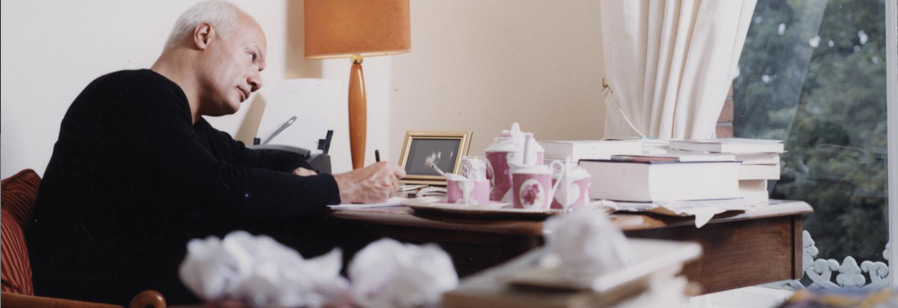
The period of research and writing was fascinating. “It involved both a lot of reading and also a lot of dreaming. I’ve always thought that dreaming – by which I mean ‘the imagination’ – was a way of exploring the world. I first got stuck into my research, and then I began to dream, generally making a big fire in the fireplace, sitting down in front of it and letting my ideas wander, hypnotised by the flames.”
His creative process worked perfectly. “My ideas suddenly took off with Mesopotamian sensations. It’s not enough just to know a lot: you’ve got to have sensations and images, you’ve got to feel the forces. Once you’ve got your intellect working, you’ve got to get your imagination working.”
A kind of trance? “Yes! It’s something I described in the first volume with Tibor, the healer, who said that, if you’re going to understand nature, you need to stare into rushing waters or the flames of a fire so as to become hypnotised and pass into a different state of awareness in order to notice the invisible links that go unnoticed. I am a great believer in the power of dreaming.”
His eternal brother
Noam, the saga’s hero, is a character who develops. For the writer, he has become a flesh-and-blood being. “It’s incredible, the place he occupies in my life. He’s my eternal brother. He has characteristics I feel very close to: curiosity, kindness and also sensuality. He is a man with passions.”
Eric-Emmanuel Schmitt affirms that he has many points in common with his character. “Noam has his own way of doing things, his obsession with Noura and his interest in medicine since he’s a healer, and he never stops moving forward. And then, all his questions about desire and feeling. I’m fully determined to follow him across several millennia.”
Next stop: Ancient Egypt
