
Le Figaro - « It affects body and soul: no one can remain indifferent. »
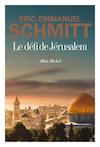
Eric-Emmanuel Schmi/ has temporarily interrupted his work on Crossing Time. Volume III of the eight volumes planned was published last year. Now, Schmi/ has produced an account of his journey of self-discovery during a pilgrimage to the Holy Land where he lived for a month. A travel book with a difference, The Challenge of Jerusalem describes, with the author’s hallmark sincerity, the discovery of his own spirituality: the spirituality of a man torn between a “Voltairean” mind, to which he lays claim, and a believer’s soul that dares to discuss its faith.
This new book harks back to Schmi/’s fabulous Night of Fire (2015), in which he described his mysQcal adventure in Tamanrasset at the entrance to the desert. In the plane to Jerusalem, he recalls: “I went into the Sahara an atheist; I came away a believer”. He was 28. Now, he is 63. The plane turns above Tel-Aviv before landing, and he recalls a second night of fire and his impassioned reading of the Books of Ma/hew, Mark, Luke and John, which he read in one go, “love-struck” by Jesus. “From that night on, the thought of Jesus never le[ me,” he admits. He went on to publish his insigh\ul The Bible According to Pilate in the year 2000, adapted for the stage under the Qtle My New Testament.
Labyrinth of Faith
With the interior décor in place, he steps into the Holy Land, where the harsh light wrests him abruptly from his daydreams. Distracted by so many marvels, he hits his head painfully in the taxi: his pilgrimage has begun, and with it, a third night of fire, this Qme in Jerusalem. The book’s secret is the unspoken soul of the city, which unveils itself brashly and powerfully, like Jerusalem itself, but also soothingly like a spiritual balm. It takes the reader by surprise, reaching out to both mind and body, leaving no one indifferent. The author ends up yielding to Jerusalem’s irresisQble lure: “I thought I was entering Jerusalem, but Jerusalem entered me”.
There’s another hidden appeal of this non-ficQonal travel book: the excitement of the group of pilgrims from Reunion Island whom the author joins, from Nazareth to the empty tomb of the Holy Sepulchre, does nothing to make up for the disappointment of anyone looking for God. Like so many pilgrims, he is disillusioned by what he sees. His fascinaQon borders on nausea, faced with the false archaeological evidence presented as arQcles of faith or, worse but very real, the angered shouts of a cleric keen to move on the massed pilgrims.
But nothing can steal the mystery from these holy sites; and therein lies the a/racQon of this book produced by a master of his cra[. In the midst of the physical quest, on which you can’t sleep at night and the smells are revolQng and religious trinket sellers exasperaQng, there’s a deeply metaphysical discovery. For no one bumps into the walls of this holy city with impunity; no one emerges untouched from this labyrinth of faith, passion, love and hatred, whether those white walls are religious or poliQcal. If the book’s Qtle is hardly original, it’s apt: “the challenge of Jerusalem” is exactly what’s involved.
One final surprise awaits in a book it’s hard to put down: the a[erword by a famous man. It’s not on the flyleaf, but Pope Francis himself has wri/en a note of thanks to Eric-Emmanuel Schmi/. The idea of visiQng the Holy Land in order to write up an account of the challenge as a travel diary came from Lorenzo Fazzini, head of the VaQcan Publishing House. Schmi/ is as famous and popular in Italy as he is in other countries, but it was his personal quest, a profane writer who’s open about his spiritual leanings, that drew a/enQon to him and opened privileged doors to him. But you wouldn’t call this a confessional book; on the contrary, it’s universal.


